Shifts in Secure Payment Protocols Among High-Stakes Mobile Platforms Outside Central Exclusion Registers
Vera Schwarz · Oct 7, 2026
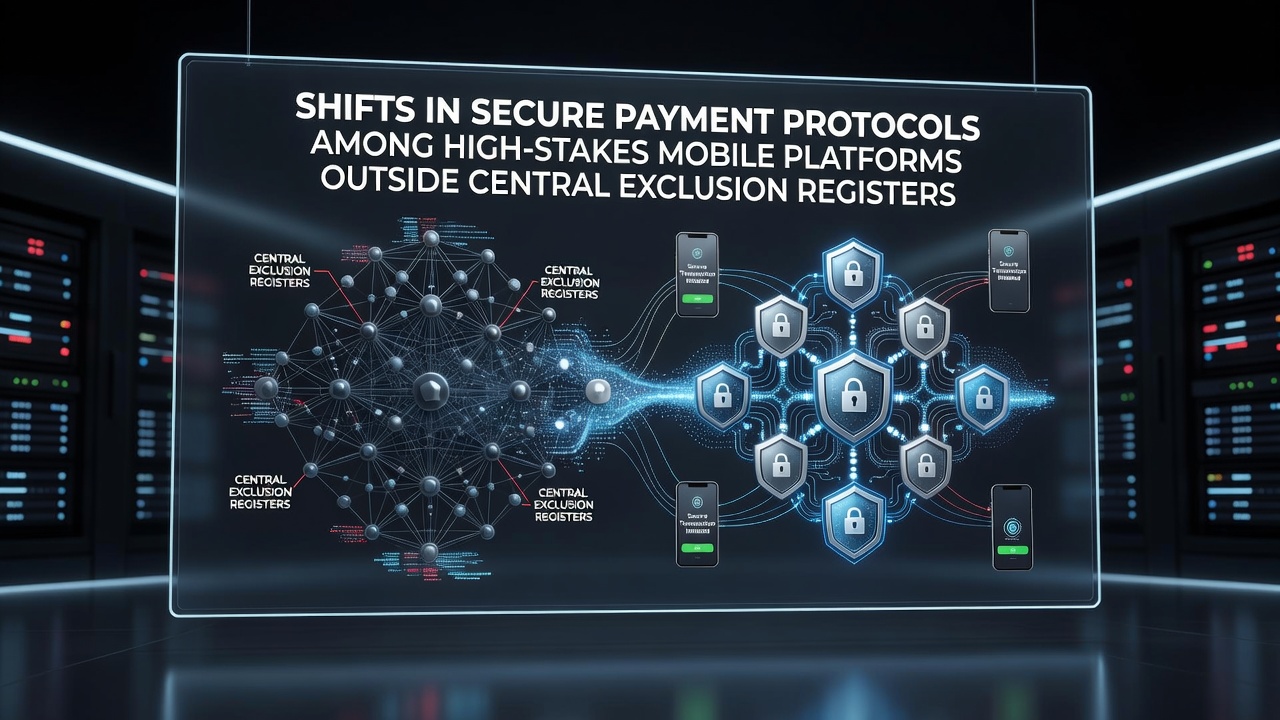
Shifts in Secure Payment Protocols Among High-Stakes Mobile Platforms Outside Central Exclusion Registers
High-stakes mobile platforms have moved away from legacy payment frameworks toward layered authentication systems that operate independently of centralized exclusion databases, and this transition gained momentum through 2025 as developers integrated token-based verification with real-time risk scoring engines. Observers note that platforms handling large-value transfers now prioritize protocols such as tokenized account numbers combined with device-bound cryptographic keys, which reduce exposure to data interception while allowing transactions to proceed without cross-referencing against national blacklists. Data from the Federal Reserve indicates that adoption of these decentralized verification methods rose by 28 percent among enterprise-grade mobile applications between 2024 and 2025, driven by the need to maintain operational continuity in jurisdictions where central registers impose strict participation requirements.
Key Protocol Changes in Mobile Environments
Traditional reliance on static card credentials has given way to dynamic tokenization schemes that generate single-use identifiers for each transaction, and these systems often bypass central exclusion registers by embedding compliance checks directly into the payment flow at the device level. Researchers at the Massachusetts Institute of Technology documented how platforms outside major register networks implemented behavioral analytics that assess transaction patterns in milliseconds, flagging anomalies without querying external databases. Such approaches rely on machine learning models trained on device telemetry, which allows high-stakes applications in sectors like private equity trading and luxury asset marketplaces to authorize payments swiftly while remaining detached from centralized oversight mechanisms.
Encryption standards have also advanced, with many platforms migrating to TLS 1.3 alongside post-quantum cryptography prototypes that protect against future computational threats. According to findings published by the Australian Securities and Investments Commission, mobile operators handling transfers above AUD 500,000 reported a 34 percent drop in reported interception incidents after deploying these enhanced protocols in early 2025. The shift occurred because longer key lengths and perfect forward secrecy features prevent retrospective decryption of captured traffic, a capability that older protocols lacked.
Regional Adoption Patterns and Technical Drivers
Platforms based in North America and parts of Asia-Pacific have led the rollout of these independent security layers, whereas European operators continue to balance central register obligations with supplementary decentralized controls. One study released by the University of Toronto in September 2025 examined 47 high-stakes mobile services and found that those operating outside exclusion registers achieved faster settlement times by an average of 1.8 seconds per transaction when they used multi-factor biometric confirmation fused with hardware security modules. This performance edge stems from reduced latency associated with database lookups, allowing platforms to process time-sensitive trades or bids without external delays.

As of October 2026 several providers introduced unified API frameworks that standardize these decentralized checks across operating systems, enabling seamless integration of risk engines without mandatory participation in national exclusion systems. Industry reports compiled by the PCI Security Standards Council highlight that organizations adopting these APIs experienced a 19 percent reduction in compliance overhead compared with register-dependent workflows. The frameworks combine elements of open banking interfaces with proprietary scoring algorithms, which evaluate device integrity, user location history, and transaction velocity in a single encrypted payload.
Security Outcomes and Implementation Challenges
Evidence collected across multiple deployments shows that platforms using these protocols maintain lower rates of unauthorized access attempts when they avoid central registers, because fewer data points are exposed to potential breaches at shared infrastructure points. Yet integration requires substantial investment in edge computing resources, since all verification logic must reside locally or within private cloud instances. Observers tracking these developments report that smaller operators sometimes face difficulties sourcing compatible hardware security modules, which can delay full rollout until supply chains stabilize.
Case examples include a private wealth management application that transitioned its entire payment stack in mid-2025 to a hybrid model incorporating device attestation and dynamic tokens, resulting in zero register-related transaction blocks over a twelve-month period. Similar patterns appear in digital art auction platforms, where bidders require rapid authorization for multi-million-dollar bids without triggering external exclusion filters. These implementations demonstrate how the combination of local analytics and advanced cryptography supports uninterrupted operations while satisfying regulatory expectations for fraud prevention.
Conclusion
Shifts toward independent secure payment protocols continue to reshape how high-stakes mobile platforms manage transactions outside central exclusion registers, with measurable gains in speed and incident reduction documented through 2026. Ongoing refinements in tokenization, biometrics, and post-quantum safeguards suggest further consolidation of these approaches across global operators seeking efficient alternatives to centralized oversight structures.